


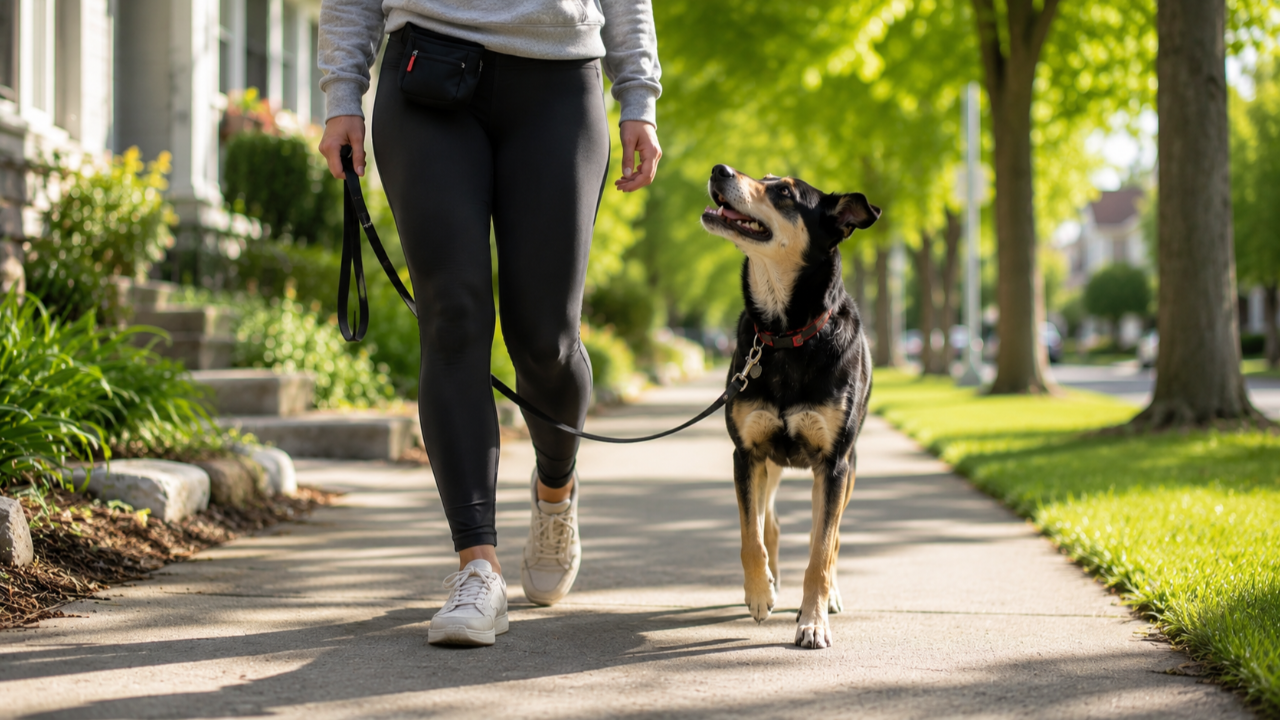
Walking a reactive dog can require more mental energy than a full day of work.
The constant scanning ahead for triggers. The route planning before you even leave the house. The crossed street, the held breath, the dog who was fine until they weren’t. The apologies to strangers, the frustration, the walk home that feels heavier than the one out.
If that’s your daily reality, we want to say something first: the work you are doing through vigilance, awareness, and careful management is not just damage control. It is training. Every time you set your dog up to succeed, every time you create distance before things escalate, every calm experience in the presence of a trigger is a deposit in an account that pays out over time.
You are doing more than you realize. And there is more you can do. Here’s how.
Before You Leave the House
The walk starts before you open the door. What happens in the minutes before you leave sets the tone for everything that follows.
Check your dog’s baseline. A dog who is already wound up from something earlier in the day, such as an exciting visitor, a frustrating interaction through the fence, or an interrupted nap, has less capacity before they hit their threshold. If they’re already elevated, consider whether this is the right moment for a walk, or whether a quieter, more open space might serve them better first.
Time your walks strategically. Quieter times of day mean fewer triggers and more opportunities for successful, calm experiences. Early mornings and later evenings are often significantly easier than peak dog-walking hours. It’s not avoidance - it’s management that creates the conditions for learning.
Choose your route intentionally. Know where the triggers tend to be and plan around them. This doesn’t mean your dog will never encounter them, but having a route in mind that gives you options and space is far better than finding yourself in a situation you can’t get out of.
Set yourself up. Loose grip, calm body, clear plan. Your dog reads you constantly through your tension, your breath, your energy. If you’re dreading the walk before you’ve even left the house, that’s information too. It may be a sign that this particular walk, at this particular moment, is too much for both of you today. There is no shame in a shorter, quieter outing, or in skipping the walk and doing something different.
Keep sessions short. A fifteen-minute walk that goes well is worth significantly more than an hour that falls apart. Plan for success as it’s easier than recovering from a reaction.
Plan for success - it’s easier than recovering from a reaction.
On the Walk
Once you’re out, distance is your most powerful tool. Everything else builds from there.
Find your working distance. This is the distance at which your dog notices the trigger but can still think, respond to you, and take treats. Below threshold is where learning happens. Above it, nothing gets through. Your job is to find that distance and work from there, gradually decreasing it as your dog is ready.
Use a C-approach rather than head-on. Curving away and around a trigger is significantly less confrontational than approaching directly. When you can, arc your path so you’re moving parallel to or away from the trigger rather than toward it. This small adjustment can make a meaningful difference to how your dog experiences the encounter.
Watch your dog, not the trigger. Your dog will tell you when they’re reaching their limit through their body language, their focus, their breathing. If you’re watching the trigger, you’re missing that information. Keep your attention on your dog and let them guide you.
Keep the leash loose. Tension travels. A tight lead communicates to your dog that something is wrong, which can increase arousal and make a reaction more likely. As hard as it is in the moment, a loose leash is one of the most important things you can offer your dog when a trigger is nearby.
Mark and reward the check-in. Every time your dog notices a trigger and chooses to look back at you, that is the moment to reward. Not after they’ve been staring for thirty seconds. The moment they choose you. That choice is what you’re building.
You are not avoiding triggers. You are managing exposure at a level where learning is possible.
When Things Go Wrong
Reactions will happen. That is not failure. It is the reality of having a reactive dog and the goal was never zero reactions.
When your dog reacts, your only job is to get out. Increase distance, stay as calm as you can, and wait for the check-in when they are able to. Not the moment they stop barking, but the moment they choose to reconnect with you. Reward that moment every time.
Having a reactive dog means reactions are part of the journey. What we’re working toward first is not the absence of reactions, but shorter ones, faster recovery, and lower intensity. That progression, through building a solid foundation over time, is what eventually changes the picture.
When a reaction happens, treat it as information. What does it tell you? Was the distance too small? Was the timing unlucky? Were you asking too much of your dog that day? Every reaction is data that helps you adjust.
The only time a reaction becomes a true failure is when we keep putting the dog back into the same situation, at the same intensity, without adjusting. That’s not training. That’s hoping for a different outcome without changing the conditions.
When you get home, notice what went well. Not just what went wrong. You got out. You stayed calm. You kept going. That counts.
Getting out is the right call. What you do next is where the learning happens.
The Bigger Picture
Proactive management isn’t just about surviving walks. It’s about building something.
Every successful walk and every outing where your dog encountered a trigger and coped gradually reduces the threshold. Every calm exposure builds a new association. Every time your dog looks to you instead of reacting, the trust between you deepens and the relationship does its work.
What you’re building is a dog who has more calm experiences than overwhelming ones. A dog who learns that the world is manageable because their person is always one step ahead. That trust, built walk by walk, is what changes the trajectory.
Steady progress with reactive dogs is easy to miss when you’re focused on what’s still hard. But it is happening. And proactive management through planning, timing, distance work, and the calm exits is a significant part of why.
You Are Doing More Than You Realize
Managing a reactive dog is hard. It is also some of the most meaningful work you can do for an animal who is struggling with the world. The guardians who stick with it and who keep showing up, keep adjusting, keep setting their dog up for the next small win are the ones whose dogs make real progress.
Reactive dogs can and do get better. Not overnight. Not without setbacks. But measurably and meaningfully better. The right support and the right approach make a real difference.
If you’re navigating this and want guidance, a plan, or simply someone who understands, we’re here. We work with reactive dogs every day and love being a part of their journey of building confidence and focus.
You are not just managing the present. You are shaping the future.
